If your attention span feels terrible at work, the fix is usually not forcing yourself to try harder inside the same distracted setup.
Most adults improve attention span by removing attention leaks, staying with one task a little longer at a time, and protecting the basics that make focus possible in the first place.
Attention span is not one fixed number stamped on your brain. It changes with the task, your energy, the number of interruptions around you, and whether unfinished work is still pulling at you in the background.
If you want the short version first, start here: silence nonessential notifications, put your phone out of reach, choose one clear next task, work in shorter timed rounds, and stop expecting strong focus from a sleep-deprived brain. If the problem has been long-running and shows up well beyond one stressful week, widen the lens. It may not be only a habit problem.
What attention span actually is, and why it feels worse at work
Attention span is how long you can keep useful attention on one thing before your mind drifts, the task quality drops, or you need a reset.
Useful attention is the key idea here. Plenty of adults can stay glued to something novel, stressful, or entertaining. The harder question is whether you can stay with a boring report, a long planning task, a document review, or a page of reading without constantly restarting your focus.
There is no single useful adult attention-span number. Your attention changes with task difficulty, interest, sleep, stress, physical state, and the number of competing inputs around you.
That is why attention often feels worse at work than it does in other parts of life. Work piles on the exact conditions that make focus fragile:
- messages and notifications
- multiple open tabs and tools
- meetings that split the day into fragments
- unfinished tasks that keep tugging at you
- low-grade background stress
- not enough real breaks
Attention also naturally shifts. Your brain is not designed to stare at one thing forever while ignoring everything else around it. That becomes a problem when modern work keeps offering new inputs every few seconds.
So if your attention span feels shorter than it used to, do not jump straight to my brain is broken.
A lot of the time, what you are feeling is the cost of too many attention restarts.
Step 1: Remove the biggest attention leaks
If you want to increase attention span and focus, start with subtraction.
A surprising number of adults try to train focus while keeping the exact same environment that keeps breaking it.
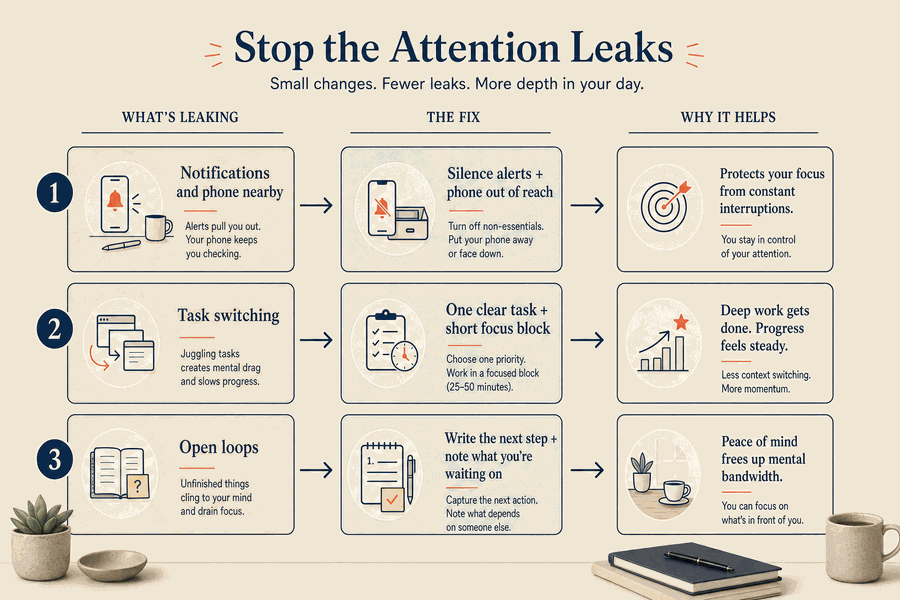
Put your phone farther away than you think you need to
A 2022 study on smartphone notifications found that people responded more slowly on trials paired with smartphone-notification sounds than on trials paired with control sounds.
That does not mean one buzz destroys your brain. It does mean your attention has a cost every time it has to orient, recover, and settle again.
So during work that actually matters:
- turn off nonessential notifications
- put your phone in another room if possible
- if you are working offline, disconnect from the internet for that block
- close tabs that are not part of the task
Face down on the desk is often not enough. If the phone is within reach, your brain still has to keep resisting it.
Stop calling task switching multitasking
Most knowledge work multitasking is just rapid switching.
Switching is not free. Research on task switching shows there is a real switch cost. People usually take longer and make more errors when they shift between tasks than when they stay with one task.
This is one reason a workday can feel like proof that you have a bad attention span when the real problem is different. You are trying to restart attention over and over.
So instead of asking, How do I focus on everything?, ask:
- What is the one task I am actually doing right now?
- What can wait 20 minutes?
- What am I pretending to do simultaneously that would go faster one at a time?
One task does not sound glamorous, but it is still the most reliable way to improve attention span in adults who do mentally demanding work.
Close open loops before you switch
Another hidden attention leak is unfinished work.
Researchers use the term attention residue to describe what happens when part of your attention stays stuck on the previous task instead of fully moving to the next one.
That is why a fragmented day can feel so mentally expensive. It is not only the number of tasks. It is the number of half-open tasks.
Before you switch, take 30 seconds and capture:
- what you were doing
- the next physical step
- anything you are waiting on
That tiny move makes it easier to come back without paying the full re-entry cost again.
Step 2: Train yourself to stay with one thing longer
Once you have removed the biggest leaks, then train attention span directly.
The mistake many adults make is choosing a focus block that is so ambitious it becomes one more thing to fail at.
Start with a round you can finish cleanly
If your attention feels shredded, do not begin with a 90-minute deep-work fantasy.
Start with a round you can actually complete while staying with the task. For some people that is 10 minutes. For others it is 20 or 25.
The goal is not to prove you are disciplined. The goal is to build a repeatable length of time where you can stay with one thing without constant switching.
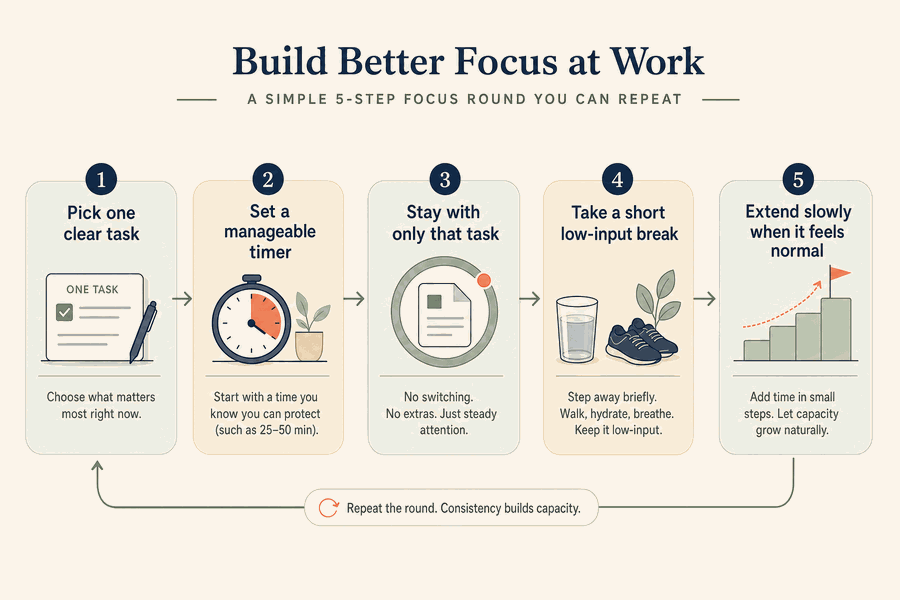
A simple progression looks like this:
- pick one task that is clear enough to start
- set a timer for a manageable round
- stay with only that task until the timer ends
- take a short break
- extend the round slowly once it starts feeling normal
That is a better way to improve attention span than repeatedly trying and failing to force marathon focus.
Use reading as a single-task drill
If you have wondered, does reading improve attention span?, the practical answer is yes, it can.
Reading gives you one object of focus. It also makes mind wandering easy to notice.
One simple drill is to read for 30 minutes and check every 5 minutes whether your mind wandered. If it did, return to the page and keep going.
The point is not perfect concentration. The point is practicing the notice-and-return cycle.
If 30 minutes feels absurd right now, start smaller. A 10- or 15-minute reading round still works. What matters is that you are practicing single-task attention instead of bouncing between short bursts of novelty.
Try a brief mindfulness reset
Mindfulness belongs in this conversation, but only if you keep it realistic.
In a study of novice meditators, a single 10-minute mindfulness session improved executive-attention performance compared with a control activity.
That does not mean you need a complicated meditation practice before work gets better. It means brief attention training can help.
A simple version:
- sit still for a few minutes
- focus on your breathing
- when your mind wanders, notice it
- return without arguing with yourself
That is the same basic skill you need during work. Notice the drift. Return to the target.
Let the first wave of boredom pass
A lot of adults think their attention span is gone when what has really changed is their tolerance for low-stimulation moments.
The second work gets a little dull, the reflex is to check something else.
If you interrupt that pattern too fast every time, attention never gets a chance to settle.
You do not need to sit there suffering for an hour. But you do need to stay with the task long enough that this is slightly uncomfortable stops automatically turning into I need a new input right now.
That is part of retraining attention span too.
Step 3: Protect the basics that keep attention from collapsing
Attention training works much better when your body and schedule are not quietly sabotaging it.
Protect sleep first
Sleep loss hits attention hard.
Research on sleep deprivation and vigilant attention shows that under-slept people have more slow responses and more attention lapses. Another review found that sleep deprivation also impairs attention and makes thinking less flexible.
That is why no focus system feels stable when you are consistently underslept.
If your sleep is poor, do not treat obvious sleep debt like something a productivity trick should overcome.
Take real breaks before focus quality collapses
Long work sessions have a time-on-task effect. The longer you stay in the same mentally demanding mode, the easier it is for attention quality to slip.
The answer is not always a long break. Often it is a real short break, taken before you are fully fried.
A real break lowers input. It might mean:
- standing up
- walking for a few minutes
- getting water
- looking away from screens
- stepping outside
- doing nothing briefly instead of opening another feed
That works better than a fake break where the original task stops but the brain keeps processing more information.
Use movement as a reset, not just as a health goal
The CDC notes that regular physical activity supports brain health and that short bursts of activity can boost memory and thinking skills.
That is useful because it makes movement practical, not aspirational.
If your attention is fading, a short walk, stairs, stretching, or a few minutes of movement may help more than sitting in the same chair trying to force another 30 minutes of low-quality focus.
Match the task to the attention you actually have
Not every hour should carry your hardest work.
If you know your mind is clearest early in the day, protect that time for writing, strategy, analysis, or planning.
If you are in a lower-bandwidth stretch, use that time for lighter admin, routine replies, or cleanup work.
A lot of adults think they need a better attention span when what they really need is a better match between task difficulty and available attention.
When a short attention span may be more than a habit problem
Not every focus problem is solved with better timers and fewer notifications.
Sometimes the right move is to widen the lens.
The CDC's adult ADHD guidance notes that adults with ADHD can struggle with managing attention, finishing lengthy tasks unless they are interesting, staying organized, and feeling internally restless. In adulthood, those patterns often become more obvious because work and life demand longer stretches of self-management.
That does not mean every distracted adult has ADHD.
It does mean ADHD may be worth considering if the pattern is:
- long-running rather than recent
- present across work and home, not only in one bad environment
- clearly impairing your daily life
- tied to repeated unfinished tasks, disorganization, or internal restlessness
It is also worth widening the lens if focus got worse alongside something else, such as:
- poor sleep or possible sleep apnea
- depression or persistent low mood
- medication changes or side effects
- hearing or vision strain
- heavy alcohol use
That kind of boundary matters because persistent concentration problems are not always best understood as a discipline failure.
If you have cleaned up the obvious distractions, improved sleep where you can, and the problem is still stubborn, severe, or clearly affecting work and relationships, talk with a clinician instead of only collecting more focus tips.
Conclusion
If you want to improve attention span as an adult at work, start by making attention easier to hold.
Cut the inputs that keep restarting it. Train longer single-task focus in small repeatable rounds. Protect sleep, breaks, and movement so your brain has a fair chance to work well.
That is a much better strategy than trying to win a daily fight against notifications, open loops, and exhaustion with willpower alone.
And if the plan is already clear but staying with the next step keeps breaking once the day gets noisy, Attention Copilot is built for that in-the-moment part of work. Teams trying to reduce the same attention drag across meetings and follow-through can also look at Attention Copilot for teams.
FAQ
Can adults improve their attention span?
Yes. Most adults improve attention span by reducing interruptions, working in shorter focused rounds, and fixing the basics that make attention fragile, especially sleep and constant switching.
Does reading improve attention span?
It can. Reading gives you one thing to stay with, and timed reading sessions help you practice noticing drift and returning to the page.
How do I know if it is ADHD or just distraction?
If the pattern is longstanding, shows up across settings, and keeps interfering with tasks, organization, or follow-through, it is worth getting evaluated. If the issue is newer or clearly tied to sleep loss, stress, or an interruption-heavy environment, start there first.