Here's an exercise you can try the next time you have a work block and feel scattered. It helps you get clear on what's important, what result you actually want, and how to go about doing it.
If you want to get work done effectively, there are a few skills to develop:
- Connecting to what todos and decisions matter.
- Naming what result you actually want.
- Clarifying your approach.
- Giving sufficient time to doing those things.
- Staying “in attention” on them as distraction and drift arise.
By effectively, I mean moving deliberately toward your goal—closer to your target, and with more speed—and with much less suffering. Less rumination, less negative self-talk, much more confidence in your process. The combo builds your self-trust about work.
You can practice these skills with a simple document. I call it a “working memory doc.” You write down the tasks, decisions, and feelings running through your head, then work through a few questions about the things you want to do.
1. Clear your “mental RAM.”
Take 3–5 minutes to write down every open loop running through your head: tasks, decisions, and your feelings about them.
Include the half-formed stuff.
- Should I do inbox email? Internal ops follow-ups?
- Need to do the outreach email.
- I feel annoyed that I haven't done this yet.
You can write it down just like that.
This clears your “mental RAM,” so to speak. You can look at what you've written instead of trying to hold all of it in your head.
If sticky emotions or reactivity arise, freewrite for a few minutes. If you have a meditation or heart practice, this is a good place to use it. Anything that gives you a sense of soothing, connection, and ground.
2. Notice what feels important and stressful.
Look through what you've written. Bold the items that feel both important and stressful, especially the ones you may be avoiding.
These are the items to spend a little more time clarifying.
3. Write down what makes each item stressful.
Notice what you feel as you look at each item. As a sub-bullet, write down what makes it feel stressful.
Be specific about your experience. You might feel annoyed at your writing ability. You might notice sadness in your chest or tension in your back. Write down what you notice.
4. Ask: “How clear does success feel?”
For each item, answer that question in a sub-bullet. If it's unclear, note down what constitutes “success criteria” for it to be done well.
For an email, you might name when you want to send it, what needs to be in it, and how you want it to sound. With those criteria written down, you can look at the draft and decide what still needs to change.
5. Ask: “How clear are the next actions?”
For each of those items, write down a few of the next actions.
Keep them concrete. Open the existing agreement. Brainstorm what needs to be different. Open the email draft and do some writing.
What this can look like
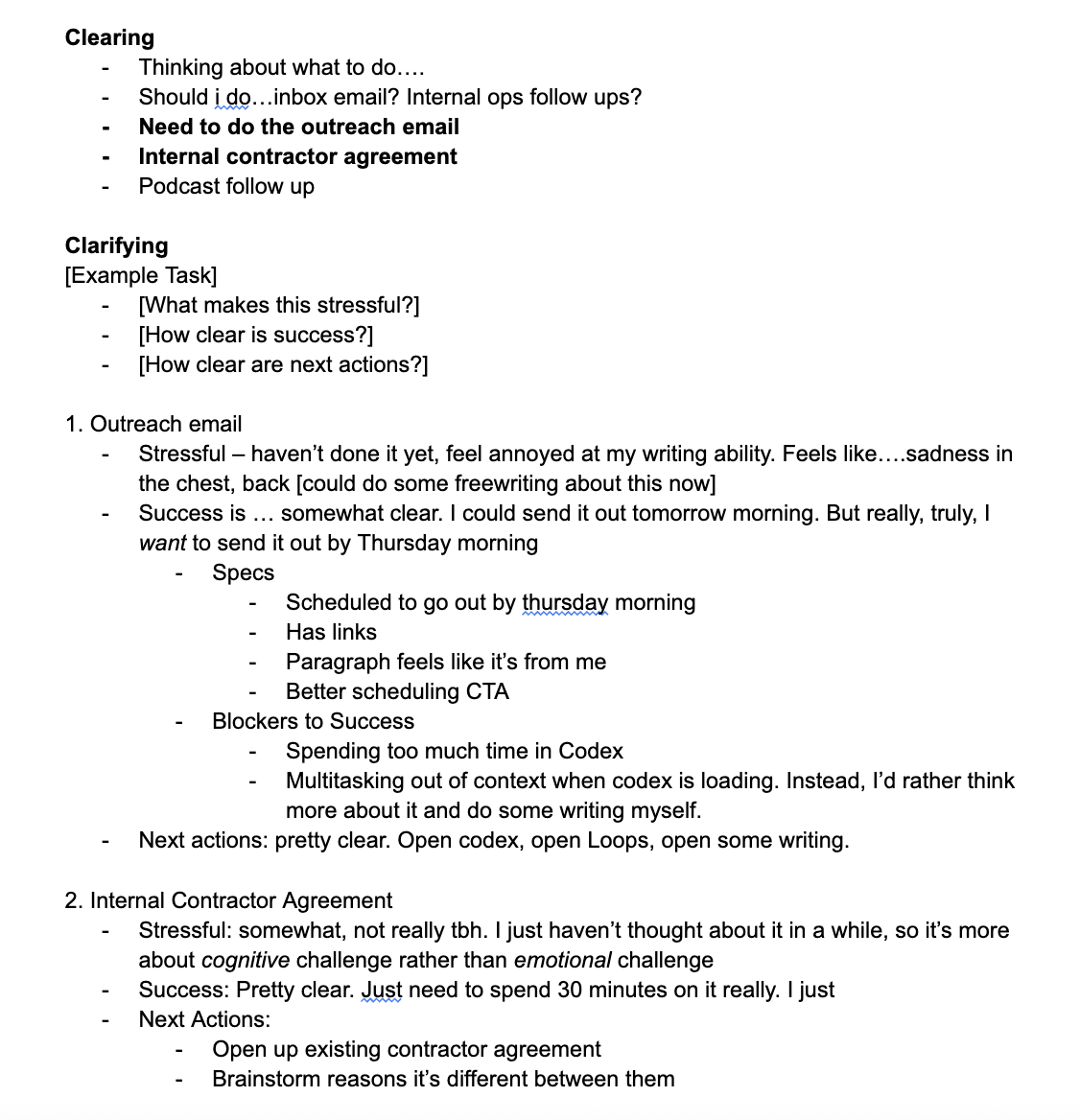
Here's an example from my own working memory doc, lightly cleaned up:
Outreach email
What makes this stressful? I haven't done it yet, and I feel annoyed at my writing ability. I notice sadness in my chest and back. I could do some freewriting about this.
How clear is success? Somewhat clear. I want to send it out by Thursday morning. It has the links, the paragraph feels like it's from me, and there's a better scheduling CTA.
Blockers to success: Spending too much time in Codex. Multitasking out of context when Codex is loading. Instead, I'd rather think more about it and do some writing myself.
Next actions: Pretty clear. Open Codex, open Loops, open the draft, and do some writing.
In the same doc, I had an internal contractor agreement to work on. That felt somewhat stressful, but I hadn't thought about it in a while, so it was more of a cognitive challenge than an emotional one. Success felt pretty clear. I just needed to spend 30 minutes on it, starting with opening the existing agreement and brainstorming what needed to be different.
Writing those things down helped me name what was stressful about each task and what I intended to do next.
6. Give yourself time to do those things.
Spend the next 30 minutes to 3 hours on those actions. Keep the working memory doc available as you work.
When you want to distract or soothe yourself, notice what you feel, capture that in the doc, and return to the next action. There's a lot more I can say about this, and I'll leave that for a separate post.
This can be challenging! When you're truly doing work at your edge, you may face bigger levels of resistance. There are inner work techniques you can learn to work with that more effectively.
Try it with your next work block. Give yourself a few minutes to get clear, then some time to do the things you've named.